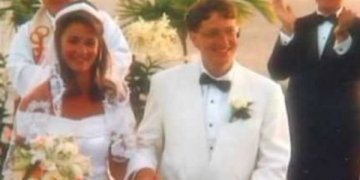






Microsoft boss and world richest man, Bill Gates, took to his blog, , this morning to espouse his affection for fanatics and the reason why he was not interested in getting married.
Those “fanatics” as well as his “fanatical” work-style was the reason.
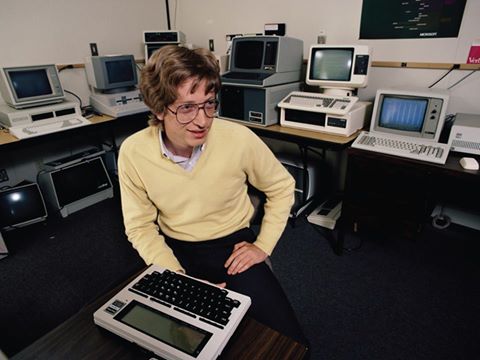
He wrote that in his 20s and early 30s, he was fanatical about software.
His words: “By 鈥渇anatical鈥� I mean that I was so focused on my vision of putting a computer on every desk and in every home that I gave up a normal existence. I didn鈥檛 take vacations or weekends off. I wasn鈥檛 interested in getting married. (Obviously, that changed when I met Melinda!) My colleagues and I at Microsoft took tremendous pride in being the first to arrive at work and the last to leave. It was an incredibly fun chapter of my life”.
He then adds that much of his work involves learning from other fanatics. “They are the scientists in search of new vaccines”, he said.
The tech boss wrote further: “Teachers working tirelessly to perfect their craft. Engineers dreaming up crazy ideas for new sources for clean energy. Being able to learn about their work and help them realize their dreams has opened up an amazing new chapter in my life.
“Looking back over 2016, I had the opportunity to meet with many gifted individuals trying to change the world.聽 Their hard work and dedication fuel my optimism that our world鈥檚 best days are still ahead of us. Here are a few of my favorite fanatics. I hope they inspire you just as much as they have me”.
Below are the fanatics and what he wrote about them:
Jimmy Carter
At 92, Jimmy Carter hasn鈥檛 slowed down. For most, being President of the United States would be the high point of their public lives. For Jimmy Carter, it was just the start of a long career dedicated to human rights causes. He鈥檚 won the United Nations Human Rights Prize and the Nobel Peace Prize.聽 He started the Carter Center, which continues to work on improving the health of the poorest, including ending guinea worm.
Nate Bowling
One of my favorite new phrases I learned in 2016 is 鈥渘erd farmer.鈥� That鈥檚 how Nate Bowling, Washington State Teacher of the Year, described his role in the classroom. 鈥淚 joke about being a nerd farmer. I鈥檓 trying to cultivate a kind of scholarship in students, and a passion for learning. So I bring passion to the classroom, and they see that and rise to the occasion,鈥� he told me during聽our meeting in June.
Nandan Nilekani
During my visit to India in November I had a chance to catch up with Nandan Nilekani, one of India鈥檚 best-known entrepreneurs, philanthropists, and thinkers. He and his wife, Rohini, have set up EkStep, a non-profit that uses smartphone-based apps to help children with early learning. Nandan and I share a common optimism about the potential of the digital revolution in India to improve lives through access to savings accounts, health records, and education.
Dr. Ana Mari Cauce
There鈥檚 an African proverb often cited at our foundation: 鈥淚f you want to go quickly, go alone. If you want to go far, go together.鈥� That was the vision behind Dr. Ana Mari Cauce鈥檚 incredible effort at the University of Washington this year to unite researchers and resources from the university and beyond to help improve the health and well-being of people around the world.
Ken Caldeira
I spent a lot of time in 2016 meeting with some amazing scientists and researchers on topics ranging from malaria to microbes. In the field of energy, one of my best teachers has been Ken Caldeira. A climate scientist at the Carnegie Institution for Science, Ken investigates issues related to climate, carbon, and energy systems.