





Akinwande Soji-Ojo
The Senate has defended key provisions of the 2026 Electoral Act, insisting that restrictions limiting political parties to direct primaries and consensus arrangements were deliberate and in line with global democratic standards.
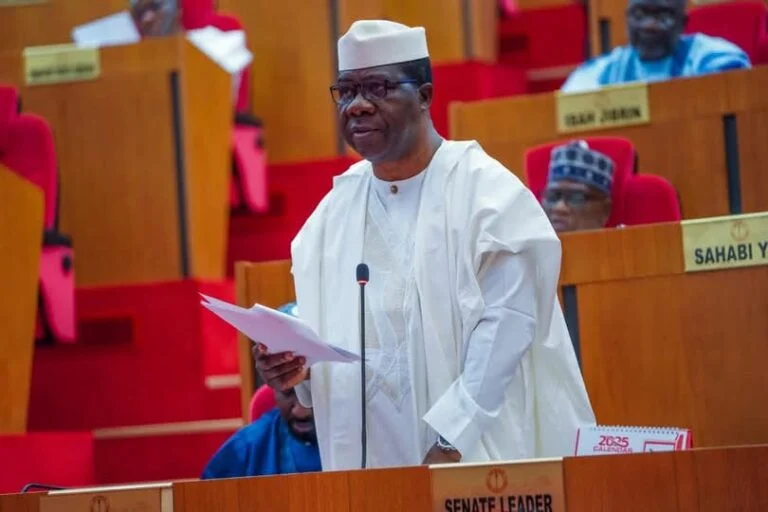
Senate Leader, Opeyemi Bamidele, disclosed this in his Easter message issued in Abuja on Sunday.
He stressed that the law was a product of broad stakeholder engagement and not an imposition by the National Assembly.
The clarification comes amid criticisms from opposition parties ahead of the 2027 general elections. Opposition figures, particularly from the African Democratic Congress (ADC), have accused the legislature of inserting provisions in the 2026 Electoral Act to weaken their chances against the ruling party.
However, Bamidele, who served on the Senate Committee on Electoral Matters, dismissed the claims, maintaining that the electoral framework reflected consensus among political actors, civil society groups, and development partners.
He justified the decision to restrict candidate nomination methods to direct primaries or consensus, saying it was aimed at curbing the influence of money in politics and dismantling the delegate system, which is often accused of being prone to manipulation.
鈥淭he provision is intentional and not self-serving. It aims at ending a delegate system that compromises the interest of the majority and strengthens the hands of moneybags to hijack primaries.
鈥淲ith the new system, we hope all party members can participate in the nomination of candidates for all elective positions transparently.
鈥淭he final decision is now in the hands of party members. It is no longer a process where aspirants openly display cash at party primary venues to compromise delegates
鈥淭his new system reinforces the principle of majority rule, which sits at the heart of democracy,鈥� Bamidele said.
The Senate Leader faulted the claims of opposition parties, noting that each provision of the Electoral Act 鈥渋s informed purely by stakeholders鈥� consensus and not by legislative fiat.鈥�
鈥淣ow is the time we must play by the rules and not against them.
鈥淥pposition parties, especially the African Democratic Congress (ADC), have repeatedly alleged that the National Assembly introduced Section 77(1鈥�7) of the Electoral Act, 2026, to frustrate their efforts to defeat the ruling party in 2027.
鈥淭hey have also criticised Section 84(1鈥�3) of the Act, which limits the procedure for the nomination of candidates for various elective positions to either direct primaries or consensus,鈥� he added.
Bamidele further stressed that the new electoral regime aligns with global best practices and is designed to strengthen internal party democracy and collective decision-making, rather than serve narrow interests.
The lawmaker also addressed criticisms over provisions requiring political parties to submit a digital register of their members to the Independent National Electoral Commission (INEC) within a stipulated time under Section 77(1鈥�3) of the Act.
鈥淭he provision was not introduced for any self-serving purpose. Rather, it is consistent with global best practices and aims at building a culture of collective decision-making that governs party politics worldwide.
鈥淢embership is the lifeblood of every political party. Every member has the right to contribute to the decision-making process of his or her party. Such a system requires functional regulations and transparency, hence the need for a digital membership register.
鈥淭he register will prevent powerful individuals, unknown to a political party, from hijacking its decision-making process,鈥� he said.
Meanwhile, the Senate has condemned recent attacks in Plateau and Kaduna States that have left scores dead, assuring that legislative efforts are underway to tackle insecurity across the country.
鈥淎s an institution that prioritises public interest and seeks collective prosperity, the National Assembly will not fold its arms and allow rogue elements to destroy the nation we are building for the next generation. We are confident that an end to such criminal acts and killings is in sight.
鈥淲e are working with the federal and state governments to address the forces driving armed attacks nationwide. This is evident in the ongoing amendment of the 2022 Terrorism (Prevention and Prohibition) Act and other legislative initiatives.
鈥淭he National Assembly is committed to ensuring stability and security across the country. The review will institutionalise stricter measures against kidnappers, their financiers, and informants. Unlike before, the consequences will now be severe,鈥� he added.