









Akinwande Soji-Ojo
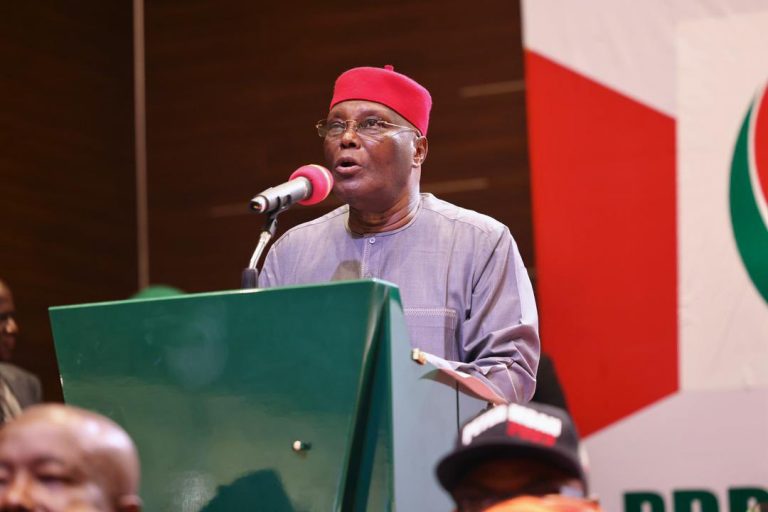
Former vice president and African Democratic Congress (ADC) presidential candidate, Atiku Abubakar, has challenged President Bola Tinubu to direct the Independent Corrupt Practices and Other Related Offences Commission (ICPC) to release former Kaduna State Governor Nasir El-Rufai if, indeed, the country’s anti-graft agencies operate under his authority.
El-Rufai has been in ICPC custody since February 19 over allegations of financial impropriety during his tenure as Kaduna State Governor between 2015 and 2023. On April 13, the anti-graft agency arraigned the former governor before the Kaduna State High Court on an amended nine-count charge bordering on alleged fraud and abuse of office.
Atiku’s challenge followed Tinubu’s directive to the Economic and Financial Crimes Commission (EFCC) to return to court and vacate the order freezing the Osun State Government’s bank accounts.
Although the president said the EFCC acted within its statutory powers, he maintained that the timing of the action, coming just days before the August 15 governorship election in Osun State, was inappropriate.
In a statement issued on Friday by his Senior Special Assistant on Public Communication, Phrank Shaibu, Atiku said Tinubu’s intervention had exposed what he described as the “myth” of the EFCC’s operational independence.
The former vice president questioned Tinubu’s claim that the EFCC had obtained a court order before freezing the Osun State Government’s accounts, noting that the commission did not mention any such order in its public explanation.
“President Tinubu’s statement has raised more questions than it has answered.
“While the EFCC’s official statement painstakingly explained why it froze the Osun State Government’s account, it made no mention whatsoever of obtaining a court order.
“Yet the president’s intervention is predicated entirely on the existence of such a court order, which he claims to have directed the EFCC to vacate.
“If indeed there was a court order, why did the EFCC omit such a fundamental fact from its official account? If there was none, then the president has introduced into the public discourse a legal process that exists nowhere in the EFCC’s own narrative,” he said.
Atiku argued that Tinubu could not claim to be detached from the EFCC’s operations while simultaneously directing the commission to discontinue its action.
“He cannot claim that he neither knew of nor interferes in the operations of the EFCC and, in the very next breath, announce that he has directed the commission to discontinue its action and return to court.
“If the EFCC promptly complies with that directive, then Nigerians have before them undeniable proof that the commission is not as operationally independent as the president wants the country to believe,” he stated.
The former vice president further argued that Tinubu’s intervention had created both a constitutional and moral obligation that should not be applied selectively.
“Having now demonstrated that he can issue direct operational directives to anti-corruption agencies whenever he considers it expedient, President Tinubu owes Nigerians an explanation as to why he cannot exercise the same authority in the case of Mallam Nasir El-Rufai.
“If he can direct the EFCC to discontinue its action today, then he cannot pretend to be powerless over the actions of the ICPC tomorrow.
“Executive power cannot be invoked selectively for political convenience while institutional independence is cited only when it suits the Presidency,” The former vice president said.
Atiku said the credibility of Nigeria’s anti-corruption institutions and the rule of law was at stake.
He added that although the decision to reverse the freezing of the Osun State Government’s accounts might ease political tension ahead of the governorship election, it failed to answer key questions surrounding the action.
“The unanswered questions remain: Who authorised the freezing of the account of an opposition-controlled state just days before a governorship election, and why was such an extraordinary action taken at such a politically sensitive moment?” he asked.