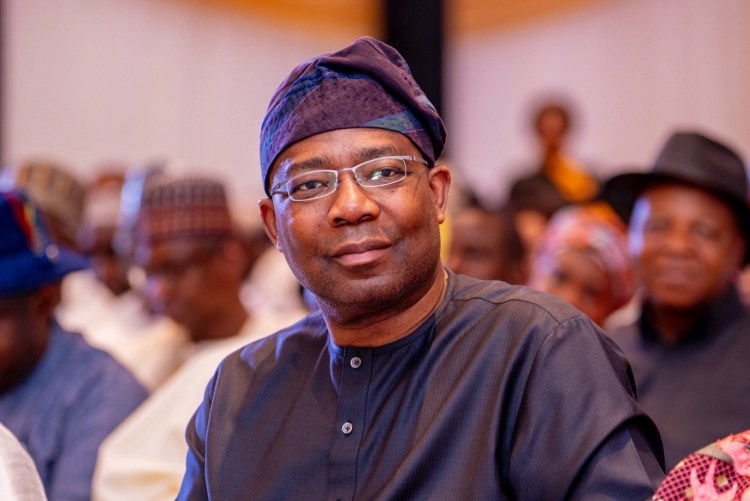






As Aigboje Aig-Imoukhuede, CFR turns 60 today, much will rightly be said about his remarkable career in business, philanthropy, public service and family life. However, I want to focus on one idea that has animated an important part of his work: his belief that transforming Africa鈥檚 public sector requires building a 鈥渃ritical mass鈥� of capable public leaders. I have heard Aig use that phrase repeatedly and, having benefited from one of the initiatives through which he pursues this vision, I have often wondered what this proposition means for the enduring African question of how strong public institutions are built.
Former US President, Barack Obama鈥檚 message to Ghana鈥檚 Parliament in 2009 that 鈥淎frica doesn鈥檛 need strongmen; it needs strong institutions鈥� remains perhaps the most memorable formulation of that question. Its appeal is understandable in a continent where personalised rule has frequently weakened institutions meant to outlive individual leaders. But it also leaves another question: who builds strong institutions? Because institutions do not exist independently of the people who lead, inhabit and reproduce them.
Nigeria鈥檚 experience demonstrates this tension particularly well. Dora Akunyili鈥檚 leadership of NAFDAC remains one of our most recognisable examples of what determined public leadership can achieve. Ifueko Omoigui-Okauru鈥檚 reforms at the Federal Inland Revenue Service provide another. Joe Abah鈥檚 doctoral thesis, Strong Organisations in Weak States helps contextualise these wins explaining how capable leadership can produce unusually effective organisations even in difficult governance environments. Abah usefully distinguishes the authoritarian 鈥渟trongmen鈥� Obama warned against from the strong men and women often required to build strong institutions.
However, the harder challenge is turning episodes of exceptional performance into enduring institutional capability. Tunji Olaopa, Chairman of Nigeria鈥檚 Federal Civil Service Commission and a longstanding scholar-practitioner of public-service reform, has written extensively about this problem. Drawing on Ladipo Adamolekun鈥檚 categorisation of Nigeria as a 鈥渉esitant鈥� public service reformer, Olaopa argues that the country can generate reform ideas and enthusiasm but often struggles to translate them into sustained improvements in performance. He emphasises that while meritocracy, professionalism, a performance orientation and institutional continuity are essential to better civil service, reform efforts must move beyond reactive and episodic interventions.
It is against this background that Aig鈥檚 proposition becomes interesting. What if, rather than waiting for exceptional public leaders to emerge episodically, we deliberately and consistently developed enough capable people to reach a critical mass? This does not resolve the old debate between leaders and institutions. It offers a possible pathway between them: invest in people who can reform organisations, connect them across the public-policy ecosystem, and sustain that investment long enough for individual capability to contribute to enduring institutional capability.
Aig鈥檚 investments in public leadership make this wager visible through three initiatives delivered in partnership with the University of Oxford鈥檚 Blavatnik School of Government. The AIG Scholarship enables exceptional Africans to undertake the Master of Public Policy, while the AIG Public Leaders Programme develops serving public officials through learning applied to practical reform challenges. The AIG Visiting Fellowship gives accomplished public leaders, including former INEC Chairman Attahiru Jega and former FIRS Chairman Ifueko Omoigui-Okauru, space to reflect on their experience and contribute to public-policy thinking. These are different interventions at different points in people鈥檚 careers, but with a common logic: identify, develop and connect public leadership capability, repeatedly and over time.
The important word, then, is not simply 鈥渓eaders鈥� but 鈥渕ass鈥�. One exceptional Director-General can significantly improve an agency鈥檚 performance; one reform-minded Permanent Secretary can change how a ministry works. However, a critical mass suggests something more ambitious: enough capable people across government for effective leadership to become progressively less exceptional. Yet capable people do not operate outside politics. Research on 鈥減ockets of effectiveness鈥� shows how political conditions can give reformers room to act, while Stefan Dercon鈥檚 work on development bargains underscores the importance of sufficient commitment among those with power to pursue development. The question, then, is whether a critical mass of capable public leaders can help turn islands of effectiveness into a wider ecosystem of effective institutions.
I have experienced something of this wager myself. The AIG Scholarship that took me to Oxford was not the beginning of my interest in public service, nor can everything I have done since be attributed to it. But it was undoubtedly a catalyst. My work and research since then have remained connected to governance, public-sector reform and relations between citizens and the state. Seven years after completing the MPP, I am returning to the Blavatnik School to join the teaching team working with another cohort of African public servants through the AIG Public Leaders Programme. This has made 鈥渃ritical mass鈥� feel less like an abstract aspiration and more like a patient process of accumulation.
Ofovwe Aig-Imoukhuede, Co-Founder and Executive Vice-Chair of the Aig-Imoukhuede Foundation, recently offered perhaps the most demanding test of that process. Reflecting on her husband鈥檚 philosophy, she described legacy not simply as what people remember about someone, but 鈥渨hat continues because of them鈥�: governance that holds, cultures that survive changes in leadership and systems that produce results when the leader is no longer in the room. The distinction goes to the heart of Africa鈥檚 leadership dilemma. The strongman makes the system dependent on himself; the institution-builder ultimately builds something capable of working without him.
At 60, perhaps the most interesting way to engage Aig鈥檚 contribution is therefore not simply to count scholarships awarded, leaders trained or programmes created, but to take seriously the proposition behind them. Africa needs strong institutions, but it also needs capable men and women who can build them, political environments that enable them, and systems capable of outliving them. Whether a critical mass can turn islands of effectiveness into an ecosystem of effective institutions will take much longer than a decade to answer. Aig has made the patient wager. Its ultimate measure may indeed be what continues because of him.
Tobe Nneli teaches on the AIG Public Leaders Programme at the Blavatnik School of Government, University of Oxford, and is a PhD Candidate in the Department of Political Economy at King鈥檚 College London.