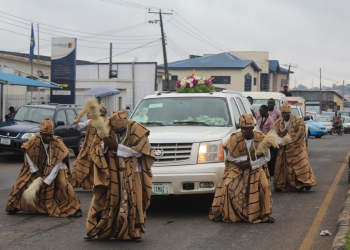
Adebayo Faleti: the Portrait of a Cultural Connoisseur
By Tunji Olaopa
As a cultural icon in the South-West of Nigeria, Alagba Adebayo Faleti speaks to an urgent necessity of inculcating the demands of cultural innovation and experience into national planning. Culture plays a significant role in many nations of the world. Take India for instance. And Faleti was a quiet reminder of that fact.
The recent death of Alagba Adebayo Faleti, father, husband, writer, poet and journalist, may not qualify as a national event. Yet we have just lost a cultural hero whose lifestyle and literary activities cut right to the heart of living for oneself and living for others. Baba Faleti could pass for an ordinary farmer in Oke-Ogun, as well as a professor of literature at any Ivy League university across the world. Thus, one immediate point of association with his memory is his easy going and quiet force of character that, I suspect, was moulded in the cauldron of a life lived within the character-forming context of the Yoruba communal values and ethos. No wonder Alagba Faleti eventually became a sturdy man of culture whose understanding projected a firm conviction about what culture can enable us to do.
Alagba Faleti however lived at a time when our world is facing a huge transformation in terms of our connectedness with others around the globe. With increasing globalisation, the world has enlarged beyond the confines of our cultural boundaries. Today, we say that the world is fast becoming a global village, but it is not a village in the sense we know a village to be. Due to the emergence of new technologies, events in several faraway places now have impacts on us and on what we think, in the same manner that things happening with our neighbours in a nearby village calls our attention instantly. If a particular type of president is elected in the United States, it automatically has several political implications for people in Africa. But the globe is also a village in a way that spells trouble for the nature of our world today. In a village, almost everyone is united by the same language and the same ethos. Thus, calling our world today a global village raises several issues that complicate the several cultural manifestations that define us. In a world where the Western/American culture has become the cultural norm, then globalisation raises critical questions. And these are questions that we really need a man of culture like Adebayo Faleti to enable us answer.
Nigeria is a multicultural country that is in a cultural mess, a defining dimension of our collective predicament that has often been neglected for far too long. One side of this is that the various mother tongues now have a marginal role in our educational curricula and even in national life. I doubt whether Nigeria is alive to the cultural imperative of the national project that requires fashioning a common purpose by which we are to live together as one unified people, and by which we can forge ahead in terms of development and progress. This is where the person and the unfortunate death of Alagba Adebayo Faleti become crucial, at the juncture of globalisation and the cultural imperatives of national development in Nigeria. Alagba Faleti grew to a ripe old age before passing on to join the ancestors. But that is not the news, even though his death would not elicit lamentation within the ontological and social requirements of the Yoruba people of South-West Nigeria. I am however certain that Faleti鈥檚 sojourn here, as journalist, writer, poet, actor and translator, points far beyond his immediate Yoruba sociocultural milieu to the larger Nigerian cultural predicament.
Alagba Faleti鈥檚 name and achievements conjure similar names of cultural trailblazers鈥擜kinwunmi Isola, Hubert Ogunde, Duro Ladipo, Babs Fafunwa, Wande Abimbola, and many others who saw into the cultural malaise Nigeria is confronted with, but also used the culture as a viable instrument with which to pass the message about the increasing emasculation of culture in Nigeria鈥檚 national scheme of things. Take two examples. Ogunde鈥檚 travelling theatre not only carried a Yoruba cultural mandate but attempted to deploy the theatre as an instrument for conscientisation on a national scale. Fafunwa鈥檚 solid effort to outline a link between mother tongue education and national development remains a critical testament to the relationship between culture, education and progress. But who remembers these icons again, except in theoretical scholarship? What has happened, for instance, to Professor Fafunwa鈥檚 cultural and educational experiment? Alagba Adebayo Faleti belongs in this illustrious and iconic group of those whose adherence to the imperatives cultural performances and the sustenance of cultural institutions should have formed a core of our national heritage as a state.
Unfortunately, while these cultural productions have done a lot, for instance through the cinema of Tunde Kelani, to orient Nollywood in a particular ideological direction, Adebayo Faleti remained at the margins of Nollywood until his death. This was someone, again like Akinwunmi Isola, whose cultural sense and being are sufficient to gift Nollywood with a deep ideological framework鈥�
Yet, when we ought to celebrate Faleti鈥檚 death, we lament as we have lamented other heroes and heroines that Nigeria have died through our neglect and national inattention. We can sum up Faleti鈥檚 life鈥檚 works in two words鈥攃ulture matters! If culture is the collective template that moulds a people鈥檚 perception of who they are and what they are capable of doing, then Faleti鈥檚 existence was a continual reminder of what we ought to have made a primary occupation in our collective attempt at forging a national direction for ourselves. In his poetry, writing and acting, for example, Alagba Faleti was always attempting to jolt our cultural memory about the ongoing denial of our cultural being in the face of modernity. His translational energies were actively functional. Translating the Nigerian national anthem from English to Yor霉b谩 could be seen as an attempt to facilitate the devolution of national memory into cultural acceptance. But more than this is his dedication to the unraveling of cultural memory, especially amongst the Yoruba. This reconnects us back to the emerging cultural hegemony of globalisation and the danger it poses to cultural memories across the globe.
Take his one and only novel, Omo Olokun Esin (translated into the English as 鈥淭he Freedom Fighter鈥�) as a deep example of how culture matters to a nation. The novel, though set in the traditional Yoruba society of the 19th century, is an attempt to come to term with the dynamics of colonisation and independence. Basorun Gaa, published in 2004, brings to life the dictatorial powers of a onetime chief in the Old Oyo Empire and how he was eliminated. In Magun (鈥淭hunderbolt鈥�), we saw the attempt to highlight the efficacy of a cultural antidote to adultery in the face of modernity. The fidelity that Faleti had to cultural memory did not prevent him from seeing how such memory could be challenged or reoriented for the sake of understanding how our contemporary society has gone along in the grip of national exigencies. His plays and poems, therefore, speak to us in their contemporariness while they are yet culturally moored in the Yoruba traditional past. Indeed, Alagba Adebayo Faleti lived his entire existence within the conviction of his culture. He spoke the Yoruba language with his accustomed gentle mien. And his dress sense, with the characteristic abeti aja cap, portrayed a cultural personality that carried the cultural message in his very person. To put this in other words, we can say that Alagba Faleti performed his culture in his very person. And so it was all too easy for him to fit easily into the few cinema productions he featured in, out of which Saworoide, by Tunde Kelani, was masterly.
Unfortunately, while these cultural productions have done a lot, for instance through the cinema of Tunde Kelani, to orient Nollywood in a particular ideological direction, Adebayo Faleti remained at the margins of Nollywood until his death. This was someone, again like Akinwunmi Isola, whose cultural sense and being are sufficient to gift Nollywood with a deep ideological framework with which to reorient Nigeria鈥檚 national project. Nollywood is a powerful medium that could instigate a strong cultural reinvention of the Nigerian nation. But alas, the movie industry is defined by those whose commercial sense stands in negative tandem to the image of a country caught in postcolonial predicament. It is not even too risky to hypothesise that Nollywood has done a lot to hurt the profile of Nigeria than any other institutions because of its urge to just project our situation rather than correcting or engaging it. And is there not only too little that such a gentle personality could achieve all by himself, or even in the company of other unassuming characters in the drama of the Nigerian state? Nollywood is performing Nigeria, but it cast characters like Adebayo Faleti in cameo or even marginal appearances!
Nigeria needs an institutional framework that allows her to critically engage her heroes and their legacies within a continuing template that allows the heroes and their heroic contributions to continue into the perpetuity of national memory, even after the death of the heroes.
Nigeria, as a performance space, does worse. I have written many pieces on the relationship that Nigeria has with her unsung heroes and heroines鈥攕tarting with Simeon Adebo, Jerome Udoji, Ojetunji Aboyade to Claude Ake, Tai Solarin, Olufunmilayo Ransome Kuti, Gani Fawehinmi, Wole Soyinka, Bala Usman; the list is endless. When delivering the eulogy at the grave of Aboyade, Soyinka was caught in a bind. He recognised the significant role that heroes played in the trajectory of nation building but he also recognised that he lost a good friend because he gave himself to a country that maliciously and inexorably squeeze life out of its true patriots. Soyinka himself has gone on after burying Aboyade to exert himself on behalf of Nigeria, yet he has been hounded unceasingly. And when the government does eventually recognise the due worth of an icon, long after the figure has received approval from the populace, we grudgingly reward them with what we consider the best Nigeria can give her sterling citizens.
Amongst his many awards, the honour of the Order of the Niger (OON) constitutes one significant step by the Nigerian government to rethink its relationship to its heroes, heroines and iconic figures. But, it seems to me that the OON is a tokenism that falls far short of what is needed. Awarding titles and building monuments are mere national gestures that bounce off the real challenge of engaging Nigeria鈥檚 national heroes and heroines. And what is needed? It is that Nigeria needs to urgently integrate her iconic figures into her project of redefinition and reinvention of her national dynamics in all its spheres鈥攃ultural, political, economic, educational, and so on. Nigeria needs an institutional framework that allows her to critically engage her heroes and their legacies within a continuing template that allows the heroes and their heroic contributions to continue into the perpetuity of national memory, even after the death of the heroes.
As a cultural icon in the South-West of Nigeria, Alagba Adebayo Faleti speaks to an urgent necessity of inculcating the demands of cultural innovation and experience into national planning. Culture plays a significant role in many nations of the world. Take India for instance. And Faleti was a quiet reminder of that fact. If according to Matthew Arnold, the British poet and critic, culture refers to 鈥渁cquainting ourselves with the best that has been known and said in the world, and thus with the history of the human spirit鈥�, then Alagba Adebayo Faleti鈥檚 existence and oeuvre did a lot in that regard. He cannot be left to the ravages of time and national forgetfulness.
Tunji Olaopa is executive vice-chairman, Ibadan School of Government and Public Policy (ISGPP); Email: [email protected], [email protected]